Today Reading Borough Council (RBC) has published a report to be discussed at the forthcoming Policy Committee meeting (RBC's executive decision-making committee) on Monday 19 January in the new Civic Offices in Plaza West. Members of the public are welcome.
This report follows on from the Education Funding Agency's (EFA's) request to RBC for help to find a community-backed permanent location for The Heights primary free school. More information can be read in my earlier post.
The report to Policy Committee proposes the scope, approach, output and timetable for the consultation which RBC officers estimate will cost about £31,000. In addition it sets out the overall decision making framework for Free Schools.
The proposed timetable is for the consultation's results to be passed on to the EFA on 30 March.
Friday, 9 January 2015
Wednesday, 7 January 2015
Fresh Proposal for the Dangerous Highmoor/Albert Road Junction
 |
| Rob Wilson MP with residents July 2014 |
It has taken Reading Borough Council’s (RBC’s) Labour
administration many years to finally acknowledge that action needs to be taken
to tackle the accident hot spot at the Albert Road/Highmoor Road junction.
When I represented Thames Ward (within which the junction is located) I
lobbied RBC for improvements to be made, the conclusion of which you can read here
but sadly the administration failed to prioritise the matter.
Last summer, following further crashes, Rob Wilson MP campaigned with local residents putting renewed pressure on RBC to
prioritise works to reduce the junction’s accident risks. This resulted in RBC recommending a closure
of the west side of Highmoor Road at the junction to general traffic with
access only remaining for emergency & refuse vehicles and also buses.
The results of Rob Wilson’s survey showed strong opposition (91%) to RBC’s proposal and, having submitted my own objections, I
was happy to see RBC accept that an alternative solution be sought.
A report to next week’s Traffic Management Sub
Committee on 15 January proposes the junction’s priorities are changed to make
traffic stop on Albert Road instead of Highmoor Road, and permitting Highmoor Road traffic to drive through the junction without stopping.
If you live in Mapledurham Ward, which is the area that I
represent (the polling station for which is Mapledurham Pavilion) do let me know what you think before the meeting. My email address is: mail@isobelballsdon.com Do copy your thoughts to RobWilsonMP@parliament.uk If you live closer to the junction (and your polling station is St Andrew's Hall) then write to my Conservative colleague Ed.Hopper47@gmail.com as he sits on the Traffic Management Sub Committee, as well as being one of the 3 local Thames Ward councillors.

Monday, 5 January 2015
Info on planning process for free schools

Today the Plain English guide to planning for free schools has been published by the Department for Communities & Local Government. Also published today is the Plain English guide to the planning system.
Readers interested in The Heights primary school's search for a permanent site may find it useful, as may those living near Crescent Road where the new Maiden Erlegh School in Reading is to be built (subject to planning).
The new primary free school (provisionally called the "Civitas Academy) in Hodsoll Road has just finished the process, having been given planning permission at last month's (December) Planning Applications Committee.
The guide does not contain new legislation, it simply sets out an overview of current planning legislation in plain English.
This
includes, for example, that each local authority is required to plan to meet current
and future needs for school provision as part of preparing a Local Plan for
their area. The most relevant section
for residents interested in the planning process relating to The Heights, the following is an extract from the guide:
Obtaining
planning permission
A
planning application for a new free school will not be submitted by the Education
Funding Agency on behalf of the free school trust until after the free school
group’s application to be a free school has been approved by the Department for
Education.
A
planning application may be required for the change of use of an existing building
and for alterations or extensions to the building as well as for 6 construction
of a new building. Full details of what is involved in the submission of a
planning application can be found on the Planning Portal and your local
planning authority’s website. (See Annex A for an overview of the planning
process).
Where
a planning application is required, the local planning authority is generally
responsible for making a decision on the proposal in the first instance.
Parties are encouraged to speak with the local planning authority about the
proposal at an early stage and in the case of free schools the Education
Funding Agency will ensure this happens.
The
Policy Statement makes clear that local planning authorities should work
positively and collaboratively. This includes engaging with pre-application discussions,
and ensuring that information requested to support the application is necessary
and proportionate.
A
local planning authority usually has up to thirteen weeks to make a decision on
the planning application for a free school. This is reduced to 8 weeks for
planning applications for minor development, such as the erection of a small
building. Some small buildings or extensions benefit from a permitted
development right (see paragraph 38 below).
Generally,
once planning permission is granted, development must be started within three
years. If work has not started by then, the applicant will probably need to
reapply. For a change of use conversion the work must have completed within
three years.
The
National Planning Policy Framework places emphasis on the need for local
planning authorities to approach decision-taking in a positive way to support
the delivery of sustainable development. The Policy Statement supports this by
making clear that there should be a presumption in favour of schools. It is
expected that any refusal of planning permission for a free school should be
clearly and robustly evidenced.
Any
planning application must be determined in accordance with the development plan
(Local and neighbourhood plans and, where relevant, the London Plan) unless
other material considerations indicate otherwise.
Many
issues are capable of being material considerations but in broad terms should
relate to the use and development of land. As a general principle, the planning
system considers what is in the public interest and matters that affect solely
private interests are not usually material considerations in planning decisions.
However, each application is considered on its merits.
Local
planning authorities can consider whether proposed development could be made
acceptable through the use of conditions or a planning obligation attached to a
planning permission. Any planning conditions including those imposed on the
planning permission for a free school will need to be clearly and robustly evidenced,
and should only be those 7 absolutely necessary to make the development
acceptable in planning terms.
Section
106 of the Town and Country Planning Act 1990 enables a local planning
authority to enter into a legal agreement (known as a “planning obligation” or
“Section 106 agreement”) with a developer to secure contributions towards the
provision of community facilities, infrastructure or services that are required
to make a proposed development acceptable.
Wednesday, 17 December 2014
Reading Museum Launches Collection Website
Reading Museum has created an online showcase that will display more than 2,700 objects from its collections, including the oil painting by Paul Sandby below of the inner gateway of Reading Abbey that connected the public outer precinct (The Forbury) to the private inner precinct where the monks lived and worked.
A major highlight for local residents will be almost 2,000 photographs of Reading during the 20th century, many from the Reading Chronicle collection.
The website will be a growing ‘shop window’ for the museum’s diverse archaeology, art, natural history, social history and world collections.
The new Collections Online catalogue has been created thanks to funding from the Arts Council England. It can be found at http://collections.readingmuseum.org.uk
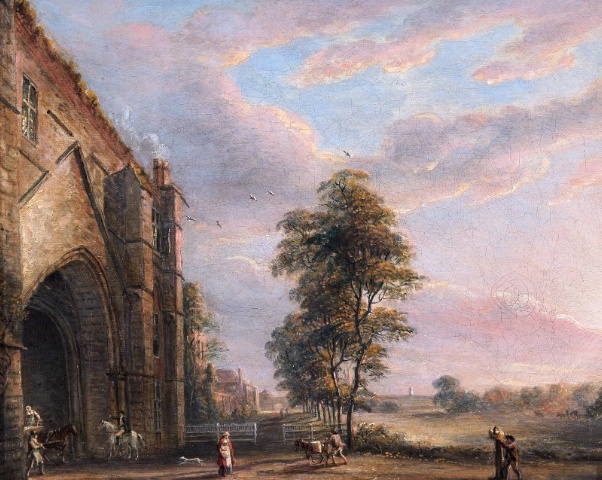 |
| Oil painting by Paul Sandby, 1808, north side of Abbey Gate |
A major highlight for local residents will be almost 2,000 photographs of Reading during the 20th century, many from the Reading Chronicle collection.
The website will be a growing ‘shop window’ for the museum’s diverse archaeology, art, natural history, social history and world collections.
The new Collections Online catalogue has been created thanks to funding from the Arts Council England. It can be found at http://collections.readingmuseum.org.uk
Friday, 21 November 2014
EFA Feedback on location for The Heights
The Education Funding Agency (EFA) has asked RBC to help find a community-backed permanent location for The Heights. Reading Borough Council has published a press release welcoming the EFA's request to help engage with the public.
The facts:
You can read the EFA's letter to Rob as well as their letter to RBC.
The Reading Chronicle has published this report and GetReading this slightly longer report. Other reactions can be read on The Heights' Facebook page.
There is a lot to be worked out and disseminated by the EFA/RBC such as how to carry out the consultation and what information is needed to ensure the consultation will generate meaningful results. I will be working hard at my jobs as councillor for Mapledurham Ward and Chairman of the Mapledurham Playing Fields Management Committee, studying the matter carefully and updating readers regularly.
The facts:
- The EFA has agreed to Rob Wilson MP's request that there should be a thorough public consultation on where the permanent location for The Heights is built. Rob's statement can be read on his website
- The EFA has indefinitely put on hold pursuing High Ridge in Upper Warren Avenue as the solution. A stated reason is "we recognise that developing the school there would be unpopular with a section of the local community"
- However the EFA states that "High Ridge presents a deliverable if not ideal solution...We are confident that a good school can be delivered on this site."
- The EFA states that the "only real alternatives to High Ridge are sites within LA ownership or held in Trust"
- The sites listed are: Mapledurham Playing Fields, Albert Road Recreational Ground and Bugs Bottom
- RBC's Policy Committee will be discussing the report (referred to in RBC's press release), on Monday 1st December. The report has this map of Mapledurham Playing Fields appended
You can read the EFA's letter to Rob as well as their letter to RBC.
The Reading Chronicle has published this report and GetReading this slightly longer report. Other reactions can be read on The Heights' Facebook page.
There is a lot to be worked out and disseminated by the EFA/RBC such as how to carry out the consultation and what information is needed to ensure the consultation will generate meaningful results. I will be working hard at my jobs as councillor for Mapledurham Ward and Chairman of the Mapledurham Playing Fields Management Committee, studying the matter carefully and updating readers regularly.
Thursday, 20 November 2014
Gridlock again in Caversham
 This morning the traffic ground to a halt across Caversham, spilling over into Reading, due to the temporary traffic lights near Caversham Bridge at the junction of Church Street and Church Road. Those drivers who abandoned the slog to cross the river either turned back home or dumped their car by the roadside.
Cars backed up from Caversham Bridge up through Caversham Heights along the A4074 all the way over the Oxfordshire boundary to the turnoff to Mapledurham House. I don't know how far on the A4155 to Henley, or indeed the Peppard Road the gridlock went, but know that it wasn't until well after 10 am that the Woodcote Road backlog was dealt with.
I spoke with Reading Borough Council's Network Manager Simon Beasley today and he explained what happened.
The temporary lights failed last night and the engineer who came out at about 11.30 pm got them back up, without realising the lights reverted to their default 3-way setting instead of the 2-way setting needed. This morning when the construction workers arrived they realised and reported the problem. However gridlock had set in across Caversham long before and by then was well established. In order to release the pressure, manual control was instigated. First the traffic from Reading, next the Henley Road approach and finally the A4074 were cleared.
The good news is the works to install the new traffic lights at the Church Street/Road junction are on schedule to finish this Sunday. Simon reassured me that if the temporary lights fail again in the meantime, the Council has notified the emergency call out engineers to reset the lights on the 2-way setting.
Once the new traffic lights are up and running do let me know if the Microprocessor Optimised Vehicle Actuation (MOVA) system makes an improvement to traffic flowing through the junction.
GetReading has the following report
Monday, 3 November 2014
Arthur Clark Care Home Site to be Leased
 |
| Arthur Clark Care Home before closure |
The Labour administration has been desperate to crack on with enabling the disused site to provide for the needs of older people in order to redeem its deeply unpopular decision back in July 2013 - opposed by Rob Wilson MP and the Conservative Group - to close the much loved local facilities. Thousands signed a petition against the closure to no avail.
You can read the report going to the Policy Committee tonight here.
Subscribe to:
Posts (Atom)